

Adult Autism & ADHD Assessment via Telehealth
Autism and ADHD testing for late-diagnosed and high-masking adults in Maryland, DC, Virginia, and Massachusetts
You've got 40 browser tabs open about it.
You've taken the online quizzes. (Twice, to be sure.)
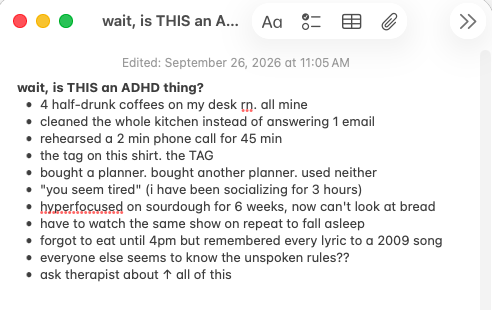
Your notes app has a running list called "wait, is THIS an ADHD thing?"
At some point, a research deep dive turns into wanting a real answer from someone who knows what autism and ADHD look like—
—especially in adults who spent decades making it look fine.
That's what we do.
At a glance
OutPsych offers autism and ADHD assessments for adults 18 and older by telehealth in Maryland, DC, Virginia, and Massachusetts. Assessments are run by psychiatric nurse practitioners Jess Romeo and Janine Michaelson, take 3 to 4 visits over 4 to 6 weeks, and cost $1,600 to $2,400 in total. You can assess for autism, ADHD, or both (AuDHD). Afterward, you can continue with the same team for medication management if you’d like to.
Who should get an adult autism or ADHD assessment?
An adult assessment makes sense when you've wondered for a while whether autism or ADHD explains patterns that other diagnoses never quite covered. You're far from the only adult asking.
The CDC estimates that about 6% of US adults have ADHD, and roughly half of them were first diagnosed as adults (Staley et al., MMWR, 2024). About 2% of US adults are autistic, most of them undiagnosed (Dietz et al., Journal of Autism and Developmental Disorders, 2020).
Some of these might sound familiar:
You got good grades, so nobody looked twice. Things fell apart in grad school, at your first real job, or the year you became a parent.
Rest doesn't restore you. It just keeps you from falling further behind.
Your "depression" has been through three SSRIs and never really budged, but the side effects were ROUGH.
You've been called too much, too intense, too sensitive. Also somehow too flat? It’s legitimately confusing to keep up.
Your queerness or your gender became the only lens anyone used, and everything else got filed under it.
Things got noticeably harder around perimenopause, after giving birth, or after a hormone change, and now you're wondering whether something was there all along.
None of these rules in a diagnosis. But they all deserve a closer look.
How is an OutPsych assessment different from other ADHD or autism testing?
Our specialty is telling autism and ADHD apart from the diagnoses they get mistaken for. Many of the adults we assess already have a chart full of labels that never quite fit.
We take a middle path. On one side, careful clinical interviewing and validated questionnaires. On the other, an understanding of neurodivergence as a way of being wired, not a list of defects.
We need both to get it right.
These are questions we find ourselves answering most often:
-
Obdurate routines, repetitive checking, and distress when things are "off" can come from obsessions and compulsions. They can also come from an autistic need for predictability. The treatments are different, so the distinction matters.
-
Both can look like exhaustion, withdrawal, and losing skills you used to have. Burnout usually follows long stretches of masking and sensory overload, and it doesn't respond to antidepressants the way depression can.
-
We regularly see adults diagnosed with bipolar disorder by clinicians who never considered an autistic or ADHD neurotype. Emotional intensity, meltdowns, hyperfocus bursts, and irregular sleep can all look like mood episodes from the outside. Sometimes the bipolar diagnosis holds up. Sometimes it doesn't, and knowing which changes your whole treatment plan.
-
Trauma and ADHD can produce similar attention and regulation problems, and plenty of people have both.
Hormones and chronic illness can blur the picture too. Attention can get worse at certain points in the menstrual cycle or in perimenopause. Conditions like POTS, hypermobility, MCAS, and sleep disorders often show up alongside neurodivergence. Neither one cancels out an autism or ADHD diagnosis. (This is where a practice that also treats hormones earns its keep. More in What Is Psychoendocrine Care?)
-
OutPsych assessments are done by two psychiatric nurse practitioners:
Jess Romeo, PMHNP-BC, founder of OutPsych.
Janine Michaelson, PMHNP-BC
The Process
What happens during an adult autism or ADHD assessment?
An OutPsych assessment has five steps: a free consultation call, online intake questionnaires, 3 to 4 interview visits, and a results visit with an optional written report. Most people finish in 4 to 6 weeks from their first call.
-
Click any "Book a free consultation" button. After you book, you'll get a short HIPAA-secure form where you can tell us about communication needs or preferences, like camera off, extra processing time, or anything else that helps.
-
A 15 to 20 minute call by phone or Zoom, depending on your provider. (We have preferences too, and we accommodate ourselves as well.)
We'll hear what's bringing you in, answer your questions, and make sure your question is one we're the right people to answer. Some are better suited to a neuropsychologist, and we'll tell you if that's the case. If it's a fit, we'll schedule your first visits.
-
You'll get an electronic packet of forms and standardized questionnaires. Plan on 45 to 90 minutes. Everything auto-saves, so you don't have to finish in one sitting. One request: once you start a standardized questionnaire, try to finish that one before you stop.
-
Expect 3 to 4 video visits of 50 to 60 minutes each, spaced 2 days to a week apart. We'll ask about your history, how your days actually go, what's hard, and what you're good at.
With your permission, we may also talk with your therapist, family, friends, or other providers. That part is optional. We may also send a few extra questionnaires to fill gaps or help tell similar-looking diagnoses apart.
-
We'll walk you through what we found in a feedback visit. If you want a written report, it covers your diagnoses and how masking and other adaptations helped you get through environments that weren't built for you. It also includes recommendations for your therapist, support for school or work accommodations, and practical strategies for daily life.
We don't guarantee any specific diagnosis. We do see high-masking autistic and ADHD adults every day, so we know what we're looking for.
-
Since we're prescribers, you don't have to stop at a diagnosis and a referral out. If you want ADHD medication management, gender-affirming care, or other care within our specialties, you can keep working with the same team that just spent a month getting to know you.
A collaborative, affirming assessment experience
-
We are skilled and thoughtful diagnosticians who are committed to getting to the root of your questions and providing insights that are actually helpful to you. We will spend extensive time conducting in-depth clinical interviewing and reviewing your responses to standardized questionnaires to truly understand your lived experiences.
You will receive a written report (if desired) that includes formal diagnoses and insight into the intersection of neurodevelopmental differences, cultural/family dynamics, secondary mental health disorders, and how masking and other trauma adaptations helped you survive oppressive environments. While no specific diagnoses are guaranteed, we are more likely than most clinicians to identify high-masking autistic and/or ADHD presentations because this is a population we work with day in and day out.
Your written report also provides information for your therapist or other supports on potential treatment targets, workplace accommodations, and neurodiversity-affirming self-care/daily living strategies.
-
Your assessment will be viewed through a neurodiversity-affirming lens, which means that we’re looking for differences, not deficits.
We aim to create an empowering experience throughout the testing process, and value your input on how we can better live up to this goal it if we ever fall short. When discussing challenges and support needs, we will consider the impact of ableism within society and the dominant neurotypical culture.
Once we identify and support neurodevelopmental differences, something amazing happens. Other mental health challenges tend to decrease. People start seeing themselves in a more positive light, feeling stronger in their unique abilities and more connected to a bigger community. They become more confident in speaking up for themselves and living their lives in more fulfilling ways.
-
OutPsych already specializes in working with queer & trans folks, and our providers are folks with lived queer and/or trans experience. We know that you deserve healthcare that affirms your gender, respects your experience living under cis-heteronormativity, and uses your name & pronouns.