Psych Meds & the Therapist's Role:
A Practical Series for Collaborative Care

Led by a Prescriber Who Actually Talks to Therapists
Psych Meds & the Therapist's Role is a webinar series for therapists led by Janine Michaelson, PMHNP-BC—a psychiatric nurse practitioner at OutPsych who spends a lot of her time coordinating care with other clinicians.
Janine works with therapists nearly every day. She's the one fielding your referrals, getting your observations about how a client is doing on meds, and calling you back when something needs adjusting, and she needs your valuable input.
And here's what she's noticed: when therapists and prescribers actually communicate, things go a lot better!
Patients get better. Treatment makes more sense.
And this series came out of that work.
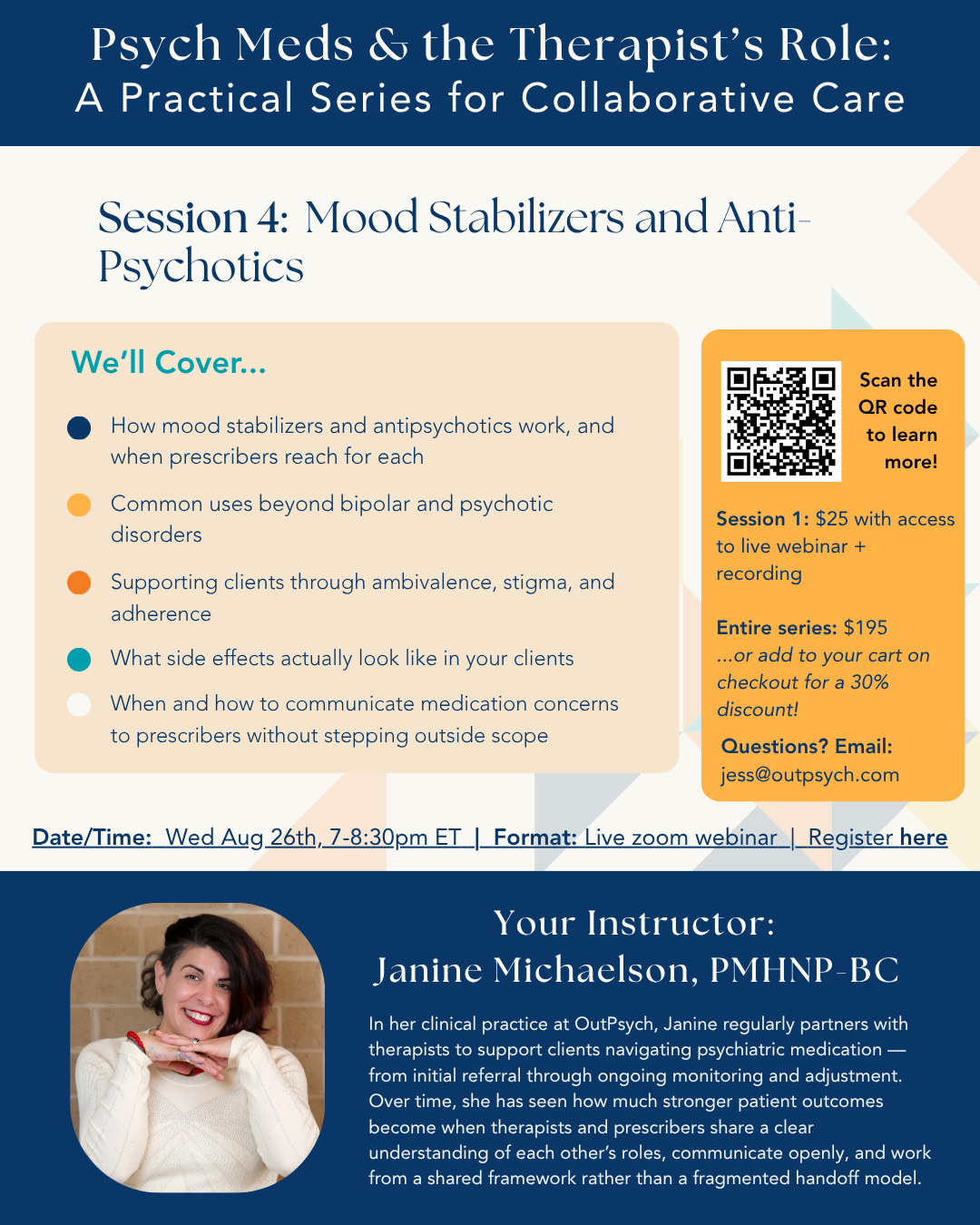
Session 4:
Mood Stabilizers and Anti-Psychotics
📆 Date: Wednesday, August 26th, 2026
⏰ Time: 7:00 - 8:30 PM ET
💻 Format: Live virtual webinar
____________________________________________________________________________
This fourth session moves into the medications that tend to feel most unfamiliar to therapists: mood stabilizers and antipsychotics.
It covers how these medications are chosen for conditions like bipolar disorder, mood instability, and psychotic disorders — but also their use in depression, PTSD, anxiety, and behavioral dysregulation. The session walks through common and serious side effects, how to tell the difference between a medication problem and a symptom of the condition itself, and what to watch for and communicate to prescribers over time. Whether your client just started lithium or has been on an antipsychotic for years, this session gives you helpful clinical context to support patients wherever they are on their medication journey.
Register for Session 4:
August 26th, 2026, 7-8:30pm ET
Psych Meds & the Therapist’s Role:
A Practical Series for Collaborative Care
This webinar series gives therapists straightforward education about psychiatric medication, referrals, and how to work with prescribers without overstepping your scope. You're often the person sitting with clients as they process what it's like to be on medication—the side effects, the hope, the frustration, the ambivalence. But most therapists were never taught what actually happens in a psychiatry visit, or how medication decisions get made. This series fills that gap.
We're not teaching you to prescribe, but we are teaching you what prescribers are thinking.
Why This Series Exists
The strongest medication outcomes tend to occur when therapists and prescribers are aligned around shared goals and have a common understanding of treatment.
Therapists often have the most longitudinal view of a client’s functioning — noticing subtle shifts in mood, affect, behavior, or side effects that may not surface in brief medication visits.
This series was created to support that role and make psychiatric care feel clearer, more collaborative, and less isolating for both clinicians and clients.
Who This Series Is For
This webinar series is for licensed therapists, counselors, and mental health clinicians who:
Work with clients considering psychiatric medication
Support clients already taking psych meds
Help clients work through side effects, hesitation, or adherence struggles
Want better communication with prescribers
This stays within your scope. We're not teaching you to manage medications.
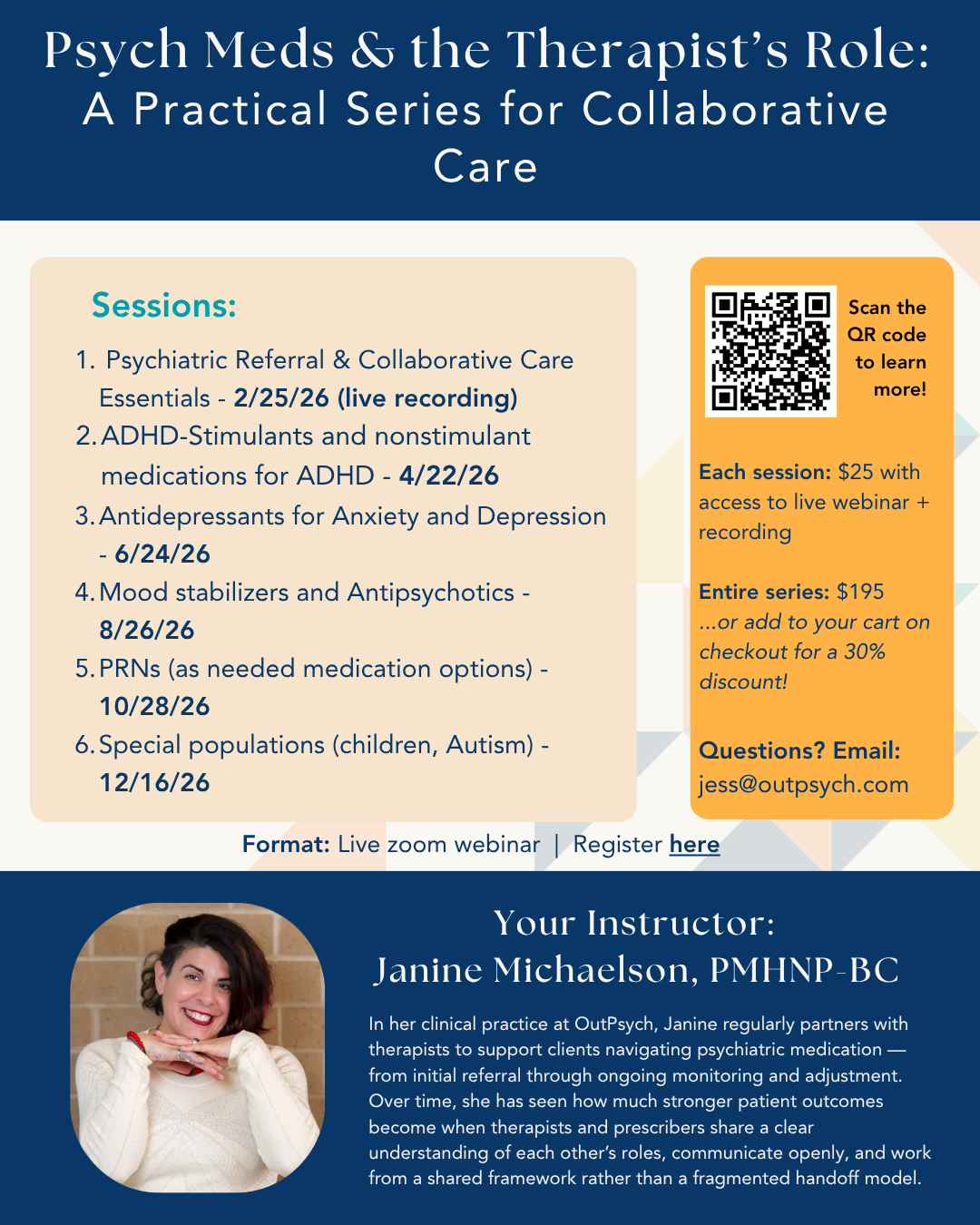
This Series Includes Six Modules:
Psychiatric referral & collaborative care
ADHD (stimulants and non-stimulants)
Depression & anxiety (SSRIs, SNRIs, and other classes)
Bipolar disorder & psychosis
PRN medications (sleep and anxiety)
Special populations (kids, neurodivergent folks, etc.)
Each session builds upon the last to create a practical and comprehensive skill set to better partner with prescribing providers, and help your clients know what to expect.
Pricing:
$25 for one 90 minute session + recording access
$195 for the entire series of 6 modules + recordings & CEs
(sliding scale access available for individual lessons - $10/learner)
Want to learn more about this webinar series?
Click the button to the right to get more details via email about what this series includes, registration details, pricing, and more.
Missed a session and want to view the recording?
Click the button to the left to go to where we keep our recordings, which you can purchase (or just log in to view them if you already purchased!)
Interested in details for the rest of the sessions?
Session 5:
PRNs (As Needed) for Anxiety and Insomnia
Date: Wednesday, October 28th, 2026
Time: 7:00 - 8:30 PM ET
Format: Live virtual webinar
This session reviews commonly used “as needed” (PRN) medications for anxiety and insomnia. It discusses when PRNs are helpful, how they are prescribed, risks such as dependence or overuse, and how therapists can support safe and effective use. Special attention is given to helping clients build insight into when and how to use PRNs appropriately.
Register for Session 5: Sign up coming soon!
Session 6:
Special Populations: Neurodiversity and Children
Date: Wednesday, December 16th, 2026
Time: 7:00 - 8:30 PM ET
Format: Live virtual webinar
This final session focuses on working with special populations, including neurodivergent individuals and children. It explores how presentations can differ, how medication decisions are adapted, and what therapists should consider when supporting these clients. The session emphasizes thoughtful, individualized care and collaboration across providers.
Register for Session 6: Sign up coming soon!
Frequently Asked Questions
-
We’re planning CE for future sessions and asynchronous recordings of these sessions. All enrollees interested in CE credits will be informed if and when this activity is approved for CEs.
-
Yes. You'll get access to the recording for 1 year if you can't make it live or want to rewatch.
-
No. This applies whether you’re working with teens, adults, children, trauma, neurodivergence—anyone who might take or consider psychiatric medication.
-
Yes. This is designed for any therapist or counselor who works with clients on or considering psych meds, regardless of license.
-
Yes. We'll have Q&A at the end, and you can submit questions anonymously in advance if you prefer.
-
Mostly presentation with case examples, plus Q&A. We're not doing breakout rooms or role-plays.
-
This is still useful. You'll understand what's happening when your clinical director or intake coordinator refers, and you'll be better equipped to support clients through the process.
-
Not at all. This applies to working with any psychiatric prescriber.
-
We'll talk about that. Communication barriers are a real issue, and we'll cover strategies for making collaboration work even when it's difficult.
-
Each live webinar is only $25 per learner. For access to the recording + future CEs, it’s an additional $15.
You can purchase access to the entire series for $295
-
Of course! Just choose the team option when you get to the registration page, and you can enroll your whole team.
If you have questions, don’t hesitate to reach out to indigo@outpsych.com for details.
Psych Meds & the Therapist’s Role
is led by Janine Michaelson, PMHNP-BC, a psychiatric nurse practitioner with extensive experience working collaboratively with therapists across a wide range of clinical settings.
In her clinical practice at OutPsych, Janine regularly partners with therapists to support clients navigating psychiatric medication — from initial referral through ongoing monitoring and adjustment. Over time, she has seen how much stronger patient outcomes become when therapists and prescribers share a clear understanding of each other’s roles, communicate openly, and work from a shared framework rather than a fragmented handoff model.
This webinar series grew directly out of that collaborative work. It is designed to make psychiatric care more transparent and accessible for therapists, while honoring the distinct roles and scopes of each discipline.