ADHD and Emotional Dysregulation: The Symptom No One Is Treating
If you have ADHD and see someone for medication management, you probably know the follow-up appointment script by heart. Your prescriber asks whether you can focus. Whether you're less fidgety. Whether the medication is "working." And you answer, because those are the questions on the table.
But here's what rarely makes it onto the table: How ADHD treatment is changing your mood.
The sudden anger that arrives before you've finished processing what happened.
The criticism that doesn't sting so much as absolutely level you (sometimes referred to as rejection sensitivity dysphoria - or RSD, for short).
The mood that swings from fine to overwhelmed in the time it takes to open your email inbox.
For a lot of people with ADHD, this emotional side is the most disruptive part of the condition. And it is frequently the part no one is treating, or asking about.
In my practice, the tell is rarely dramatic. Someone starts a stimulant for focus, and a few weeks later they mention, almost as an aside, that they're not snapping at their kids as much. Or the hopelessness about their career mysteriously lifted and they hadn't connected it to the medication. Or the rumination they'd chalked up to depression (or just accepted as accurate, if harsh, self-assessment) got quieter.
They didn't come in asking for help with emotional dysregulation. They didn't know that's what it was. They thought it was a separate mood problem, or just who they were—an even more devastating belief.
Is emotional dysregulation actually part of ADHD?
Yes. It is a real, core feature of the condition, not a character flaw and not a lack of willpower.
Emotional dysregulation means having difficulty managing the intensity and timing of emotional reactions: reacting more strongly than a situation calls for, and having a harder time calming back down. In ADHD, this shows up as a short fuse, low frustration tolerance, moods that shift quickly, and a heightened sensitivity to feeling rejected or criticized.
Research consistently shows that people with ADHD use more maladaptive emotion-regulation strategies, and that these difficulties track closely with symptom severity, executive function problems, and coexisting conditions. Some leading researchers have argued that emotional impulsivity is central enough to ADHD that it belongs in the diagnostic criteria, though experts don't fully agree yet, and current diagnostic manuals still leave it out.
Here's what matters clinically: emotional dysregulation predicts greater difficulty in daily life, in relationships, at work, and in self-esteem, above and beyond the classic symptoms of inattention and hyperactivity. People whose ADHD includes prominent emotional dysregulation tend to have more coexisting conditions and more severe impairment. Better emotional regulation over time is linked to a smoother course of ADHD into adulthood.
Emotional dysregulation also helps explain part of why ADHD so often precedes later anxiety and depression, though it's not the whole story. Genetically informed studies attribute much of the link between ADHD and emotional problems to shared genetic factors, so emotional dysregulation is one mechanism operating alongside common inherited vulnerability rather than the sole cause. Longitudinal data tracking children into young adulthood supports this picture, as do twin studies examining the genetic and environmental contributions.
That thread is the one worth sitting with. We treat ADHD. Then anxiety shows up. Then depression. And sometimes the connection running through all three was emotional dysregulation that nobody named.
What's happening in the brain?
In ADHD, the brain regulates emotion less efficiently: fast-reacting deep-brain circuits, including the amygdala, generate strong emotions, and the prefrontal cortex is slower to rein them in.
A useful way to picture it: the brain has an emotional accelerator and an emotional brake. The amygdala and related structures act like the accelerator, generating fast, strong emotional reactions. The prefrontal cortex, the front of the brain behind your forehead, acts like the brake, dampening those reactions and putting them in context.
In ADHD, the communication between the brake and the accelerator is less efficient. Emotions fire quickly and intensely and take longer to settle. Newer models describe ADHD as a difference in how the brain regulates itself from the top down (Amiri et al., 2026).
Brain chemistry plays a role too. ADHD has long been linked to dopamine and norepinephrine, but recent work highlights serotonin, a chemical involved in mood, as another contributor. Serotonin pathways feed into the same emotion-related brain regions. A 2025 review found serotonergic pathophysiology in 135 of 182 ADHD-associated comorbidities, about 74%.
But hold on before you wonder whether lexapro will do the trick: serotonin appears to be one contributor among several, not the single cause of emotional symptoms in ADHD. As always, the neurochemistry is more complex than any one-chemical explanation. And that deeply matters because it changes what treatment looks like.
Is this bipolar disorder? Is it borderline?
In short, no—strong emotional reactions do not automatically mean you have bipolar disorder or a personality disorder (or a disorder at all, for that matter). I’ve seen a lot of ADHDers (especially cis women diagnosed as adults) carry bipolar or borderline diagnoses when the real diagnosis was ADHD the whole time.
Since emotional dysregulation is so visible, people with ADHD (and sometimes their clinicians) mistake it for something else. Two conditions come up most often. The table below summarizes the distinguishing features.
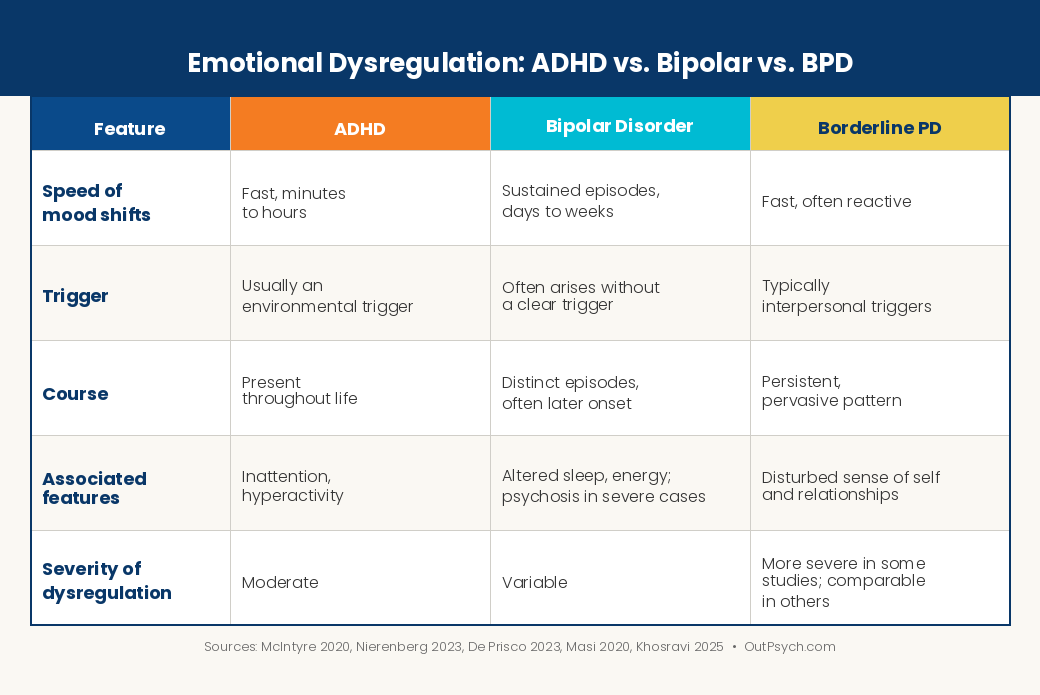
(Sources: McIntyre 2020, Nierenberg 2023, De Prisco 2023, Masi 2020, Khosravi 2025)
ADHD mood shifts vs. bipolar disorder:
ADHD emotional swings are usually fast, minutes to hours, triggered by something in the environment, and present throughout life. Bipolar mood episodes are usually sustained, days to weeks, and can arise on their own without a clear trigger. They come in distinct episodes and often bring other changes like altered sleep or, in severe cases, psychosis. Bipolar disorder also tends to start later than ADHD. Emotional dysregulation actually appears across many mental health conditions rather than pointing to just one, which is exactly why professional evaluation matters. In young people, the overlap between ADHD and bipolar spectrum symptoms is a well-documented reason ADHD sometimes gets misdiagnosed as bipolar disorder.
ADHD vs. borderline personality disorder (BPD):
Emotional dysregulation is central to BPD as well; some studies find it more severe in BPD, while others find no meaningful difference in the degree of dysregulation between the two. BPD also involves a core disturbance in relationships and sense of self that is not central to ADHD. The two conditions genuinely co-occur fairly often, so this isn't simply a matter of one being mistaken for the other. Schema-based research is helping clarify what drives emotional dysregulation differently in each condition.
A note on "rejection sensitive dysphoria": Many people with ADHD describe intense pain around perceived rejection or criticism, and research does link ADHD to heightened rejection sensitivity that affects mood and relationships. Research on rejection sensitivity in children and adolescents with ADHD has confirmed the pattern across age groups. Officially, it is a popular term but not an official diagnosis, and the formal research on it is still limited. That doesn't mean the experience isn't real.
Bottom Line: if emotional instability is persistent, severe, or centered on relationships, it deserves a careful evaluation. But strong emotions alone don't mean you have something other than ADHD.
Do stimulants help emotional symptoms?
More than most people think, though not completely.
This is where the popular narrative gets it partly wrong. Stimulants weren't designed only for focus, and the evidence shows they help emotional symptoms too, sometimes nearly as much as they help attention, though the benefit is less consistent from person to person.
A 2026 clinical trial (Gao et al.) found that both a stimulant (methylphenidate) and a non-stimulant (atomoxetine) significantly reduced emotional lability in children with ADHD. The improvement held up even after accounting for better attention, meaning it wasn't just a side effect of focusing better. A review of the research found that methylphenidate reduces temper problems, emotional over-reactivity, and irritability, though the size of the benefit varies from person to person.
There's an important catch. Not all stimulants behave the same way for mood. Methylphenidate-type medications tend to reduce irritability, while amphetamine-type medications can increase it in some people, especially at higher doses and in younger children. A meta-analysis of irritability risk confirmed stimulants can cause irritability in some children, and analyses of adverse drug events related to mood in pediatric patients found differences between medication classes. FDA adverse event data (Pozzi et al., 2019) tells a similar story. Irritability and moodiness are also recognized possible side effects of stimulants, documented in both JAMA trials and systematic reviews.
One caution for the youngest patients: preschool-aged children may experience increased mood lability and dysphoria on stimulants, which is why the AAP clinical practice guideline urges extra care with stimulant use in this age group.
So the accurate message isn't "stimulants don't work for emotions." It's that stimulants help many people's emotional symptoms, but the benefit is partial and inconsistent, some people need more than medication alone, and the specific medication matters. The real problem is that emotional symptoms often go unmeasured and unaddressed in routine care.
One place this shows up in practice: drug holidays. In my practice, I treat tolerance as real and use planned days off as one way to manage it. But when a stimulant is doing significant mood work, not just focus work, taking a full holiday can mean a day of irritability, emotional flooding, or rumination that the patient (and their family) doesn't want to repeat. So sometimes we don't take holidays. Sometimes we try half-holidays, cutting the dose rather than stopping it. This is one reason I like chewable XR stimulants: they let you split a dose cleanly when you need a middle ground.
What actually helps?
The most effective approach is an optimized stimulant combined with behavioral or psychological support. For many people, that combination alone reduces emotional dysregulation significantly. Start with the basics: get the stimulant right first.
When that isn't enough, there are medication add-ons. When emotional symptoms or aggression persist, clinicians may consider additional medications. There is RCT-level evidence for adding risperidone or aripiprazole for persistent aggression or methylphenidate non-response, with divalproex, molindone, and SSRIs also described as adjuncts; stimulants are generally prioritized before antipsychotics. Non-stimulant ADHD medications such as atomoxetine can also improve emotional lability (Gao et al., 2026). These are decisions to make with a prescriber who's actually asking about your emotional symptoms, not just your focus.
Non-medication approaches with evidence: Cognitive behavioral therapy (CBT) improves emotional symptoms in adults with ADHD, with some evidence that gains hold at follow-up, though the long-term data is still limited (López-Pinar et al., 2026) and quality-of-life improvements have been less consistent. Parent training and social skills training help emotional symptoms in children (Guo et al., 2022). Psychological and psychosocial care is recommended as part of the treatment picture precisely because medication alone often leaves emotional symptoms under-treated.
Neurofeedback is being studied. One 2026 trial (Bohner et al.) found it comparable to methylphenidate for some internalizing emotional problems, but the medication had stronger effects on emotional dysregulation overall. A larger 2025 meta-analysis found no support for neurofeedback as a stand-alone ADHD treatment, with methylphenidate superior for core symptoms. Neurofeedback remains investigational.
Medication helps. It rarely does the whole job. The people who do best are the ones getting both.
What's new in the research (2024 to 2026)?
A 2025 review established serotonin as a meaningful contributor to ADHD and its related conditions, alongside dopamine and norepinephrine, supporting a broader view of ADHD brain chemistry rather than a serotonin-only explanation.
A 2026 model (Amiri et al.) connected the brain's emotion-regulation circuitry to self-regulation difficulties in ADHD, offering a more integrated picture of how emotional and cognitive symptoms relate.
A 2026 clinical trial (Gao et al.) provided some of the strongest recent evidence that both stimulant and non-stimulant medications reduce emotional dysregulation directly, not just as a downstream effect of better focus.
And one important thing that hasn't changed: no major diagnostic guideline in 2024 to 2026 has added emotional dysregulation to the official ADHD criteria. It remains a well-recognized but not-yet-formalized part of the condition. The science is ahead of the manuals.
What this means for your care
Emotional dysregulation is one of the most impairing and least-discussed parts of ADHD. It drives much of the real-world difficulty people experience, and it is frequently mistaken for bipolar disorder or borderline personality disorder. The good news: it is treatable, through medication (which helps more than commonly assumed, though not completely), therapy, and skills training.
If your emotional symptoms have never come up in an appointment, raise them. Ask your prescriber directly: "Are my emotional reactions part of my ADHD, and are we treating them?"
It may be the most important question no one is asking you.
Corrections and clinical notes
Where this article simplifies the science a bit: The "accelerator and brake" metaphor is a simplification of the striato-amygdalo-medial-prefrontal model described in current research. It captures the core dynamic accurately but omits the role of additional circuits and feedback loops. The drug-holiday discussion reflects clinical opinion and practice experience, not published evidence for tolerance-countering efficacy.
A note on this article: This content is based on current evidence as of August 2026 and reflects OutPsych's clinical perspective. This is educational content, not a substitute for individualized psychiatric care.
References
Soler-Gutiérrez AM, Pérez-González JC, Mayas J. Evidence of emotion dysregulation as a core symptom of adult ADHD: A systematic review. PLoS ONE. 2023;18(1):e0280131.
Barkley RA. Emotion dysregulation is a core component of ADHD. In: Barkley RA, ed. Attention-Deficit Hyperactivity Disorder. 4th ed. Guilford Press; 2015:81-115.
Faraone SV, Rostain AL, Blader J, et al. Practitioner Review: Emotional dysregulation in attention-deficit/hyperactivity disorder — implications for clinical recognition and intervention. J Child Psychol Psychiatry. 2019;60(2):133-150.
Graziano PA, Garcia A. Attention-deficit hyperactivity disorder and children's emotion dysregulation: A meta-analysis. Clin Psychol Rev. 2016;46:106-123.
Beheshti A, Chavanon ML, Langen KJ, Lehr T. Emotional dysregulation in adults with attention deficit hyperactivity disorder: A meta-analysis. BMC Psychiatry. 2020;20:120.
Bunford N, Evans SW, Wymbs F. ADHD and emotion dysregulation among children and adolescents. Clin Child Fam Psychol Rev. 2015;18(3):185-217.
Riglin L, Eyre O, Cooper M, et al. Investigating the genetic underpinnings of early-life irritability. Transl Psychiatry. 2022;12:197.
Banaschewski T, Becker K, Döpfner M, et al. Emotional dysregulation in children and adolescents with ADHD — a prospective longitudinal study. J Abn Child Psychol. 2020;48(2):273-286.
You H, Bai Y, Liu Y, et al. Multimodal assessment of genetic and environmental contributions to ADHD and emotional problems. Twin Res Hum Genet. 2024;27(1):1-10.
Amiri S, Sadeghi-Bazargani H, et al. A top-down self-regulation model of ADHD. Front Psychiatry. 2026.
Ozel-Kizil ET, Kokurcan A, Aksoy UM, et al. Serotonin in ADHD and its comorbidities. Neurosci Biobehav Rev. 2016;71:726-735.
Maltezos S, Horder J, Coghlan S, et al. Serotonergic pathophysiology in ADHD-associated comorbidities: A systematic review. Neurosci Biobehav Rev. 2025;164:105798.
McIntyre RS, Berk M, Brietzke E, et al. Bipolar disorders. Lancet. 2020;396(10265):1841-1856.
Nierenberg AA, Agustini B, Grunze H, et al. Diagnosis and treatment of bipolar disorder: A review. JAMA. 2023;330(14):1370-1380.
De Prisco M, Tonna M, Maina G, et al. Emotional dysregulation across psychiatric conditions: A transdiagnostic systematic review. Eur Psychiatry. 2023;66(1):e89.
Masi L, Gignac M. ADHD and comorbid disorders in childhood psychiatric problems. Curr Dev Disord Rep. 2020;7:162-171.
Khosravi M, Kasaei M. Schema-based emotional dysregulation in ADHD and BPD. J Clin Psychol. 2025.
Babinski DE, Waschbusch DA. Rejection sensitivity in ADHD: A systematic review. ADHD Atten Def Hyp Disord. 2025;17:1-18.
Bondü R, Esser G. Justice and rejection sensitivity in children and adolescents with ADHD symptoms. Eur Child Adolesc Psychiatry. 2015;24(2):185-198.
Gao Q, Chen J, et al. Stimulant and non-stimulant effects on emotional lability in ADHD: A randomized controlled trial. J Child Psychol Psychiatry. 2026.
Lenzi F, Cortese S, Harris J, Masi G. Pharmacotherapy of emotional dysregulation in adults with ADHD: A systematic review and meta-analysis. Neurosci Biobehav Rev. 2018;84:359-367.
Stuckelman ZD, Mulqueen JM, Ferracioli-Oda E, et al. Risk of irritability with psychostimulant treatment in children with ADHD: A meta-analysis. J Clin Psychiatry. 2017;78(6):e648-e655.
Ramstad E, Storebø OJ, Gerner T, et al. Adverse event reporting for methylphenidate and amphetamine in pediatric ADHD. Eur Neuropsychopharmacol. 2018;28(8):899-914.
Pozzi M, Bertella S, Guzzetti S, et al. FAERS analysis of mood-related adverse events in ADHD medications. J Clin Psychopharmacol. 2019;39(4):386-391.
Cortese S, Adamo N, Del Giovane C, et al. Comparative efficacy and tolerability of medications for ADHD in children, adolescents, and adults: A systematic review and network meta-analysis. Lancet Psychiatry. 2018;5(9):727-738.
Elliott J, Johnston A, Husereau D, et al. Pharmacologic treatment of ADHD in adults: A systematic review and network meta-analysis. JAMA. 2021;4(6):e2112536.
Wolraich ML, Hagan JF, Allan C, et al. Clinical practice guideline for the diagnosis, evaluation, and treatment of ADHD in children and adolescents (AAP). Pediatrics. 2019;144(4):e20192528.
Faraone SV, Banaschewski T, Coghill D, et al. The World Federation of ADHD International Consensus Statement. Neurosci Biobehav Rev. 2021;128:789-818.
Guo Y, Schmitz TW, Mur M, et al. Parent training and social skills training for emotional symptoms in children with ADHD. J Atten Disord. 2022;26(10):1307-1319.
Nimmo-Smith V, Merwood A, Hank D, et al. Psychological interventions recommended for ADHD. BMC Psychiatry. 2024;24:115.
López-Pinar C, Martínez-Sanchís S, Carbonell-Vayá E, et al. Long-term efficacy of CBT for adults with ADHD: A meta-analysis. J Atten Disord. 2026.
López-Pinar C, Martínez-Sanchís S, Carbonell-Vayá E, et al. CBT for adults with ADHD: A systematic review and meta-analysis. J Atten Disord. 2018;22(9):859-873.
Bohner M, Gevensleben H, et al. Neurofeedback vs. methylphenidate for emotional symptoms in ADHD: A randomized trial. 2026.
Yan L, Wang S, Yuan Y, Zhang J. Neurofeedback for ADHD: A meta-analysis of randomized controlled trials. J Atten Disord. 2025;29(3):210-225.
SEO metadata:
Slug: /adhd/emotional-dysregulation-adhd
Meta description: Emotional dysregulation is one of the most impairing parts of ADHD, and most prescribers aren't asking about it. Here's what the research says and what to do.
Primary keyword: ADHD emotional dysregulation
Secondary keywords: ADHD mood swings, ADHD and emotions, rejection sensitivity ADHD, ADHD vs bipolar, emotional symptoms ADHD treatment
Schema type: MedicalWebPage + FAQPage